
When a commercial excavator, loader, forklift, or other heavy machine leaves a Langley Township yard, the handoff is not the end of the seller’s questions. Fluids, batteries, filters, tires, attachments, and mixed metal can follow different handling routes. A clear post-pickup conversation helps a business keep its own records accurate without guessing what a receiving facility or carrier will accept. Call (236) 900-3163 to talk about your machine.
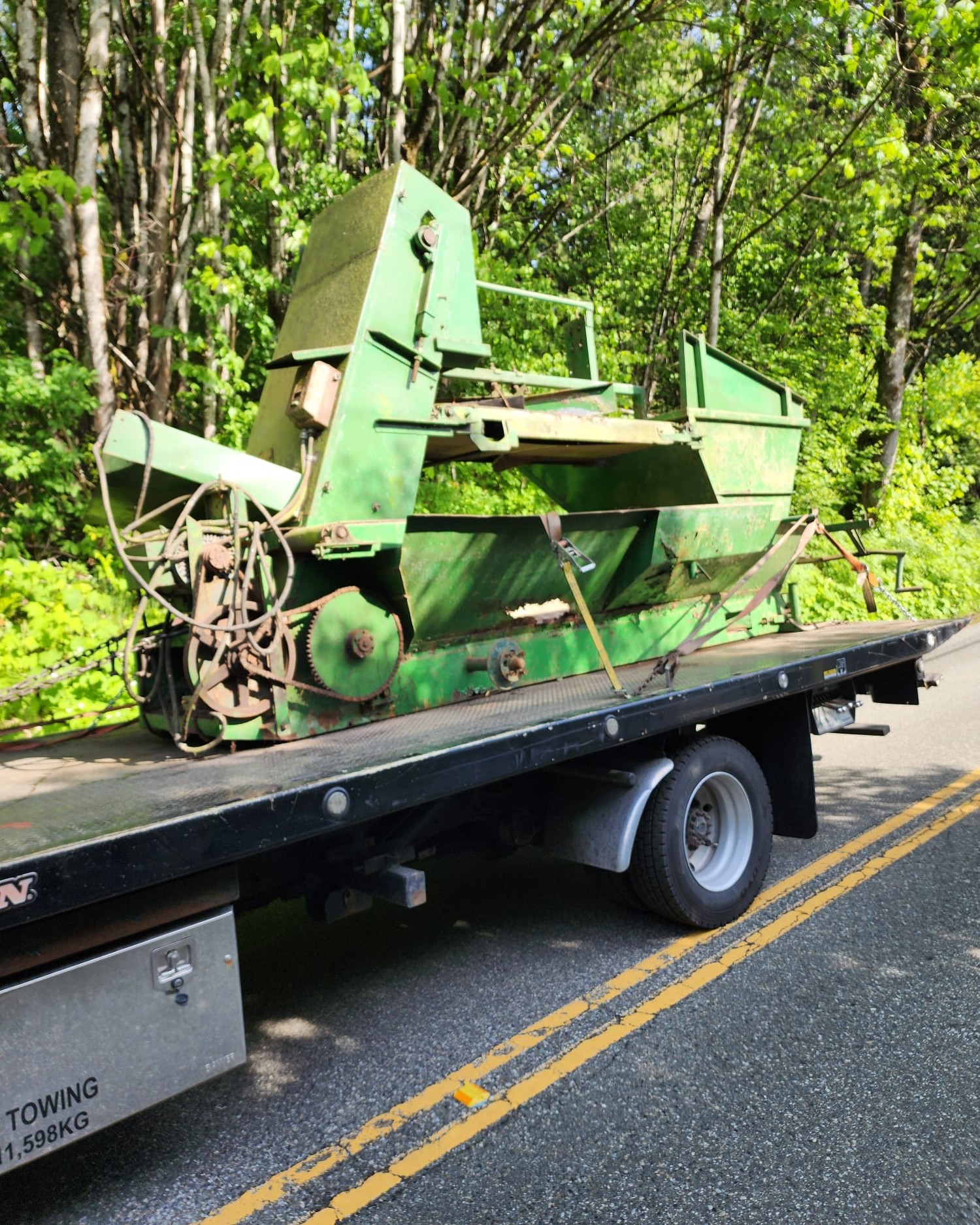
This guide is for commercial owners in Langley Township and the Lower Mainland who want to understand the fluid and material questions that arise after heavy-equipment removal. It does not promise a particular recycling result, price, schedule, licence, or government outcome. Instead, it sets out what to identify, what to ask, and which official rules and facilities are relevant.
Start with a factual post-pickup inventory
Use the equipment’s make, model, unit number, and internal asset identifier to create a simple handoff record. Note whether the machine still contained engine oil, hydraulic fluid, transmission fluid, gear oil, coolant or antifreeze, diesel, gasoline, brake fluid, grease, or another liquid. Also record visible batteries, oil filters, fuel tanks, tires, tracks, hoses, attachments, and loose parts. A photograph of labels or a written fluid list can help distinguish a known product from an unidentifiable one.
Do not treat “fluid” as a single waste category. Metro Vancouver’s official United Boulevard Recycling and Waste Centre page defines its accepted oil category broadly: used oil includes petroleum or synthetic crankcase oil, engine oil, hydraulic fluid, transmission fluid, gear oil, heat-transfer fluid, and other lubricating fluid used in machinery or equipment. The same page says used oil should be brought in its original container so the container can be recycled. That description is useful when asking a receiving facility about a machine’s hydraulic or gear oil, but it does not mean every facility accepts every commercial load.
Separate fluids that need a specific answer
- Oil and hydraulic fluid: identify the fluid and approximate quantity separately. Ask whether the receiving location accepts the material from a commercial source and whether it requires original containers, sealed containers, or another packaging method.
- Antifreeze or coolant: record whether it is known, mixed, contaminated, or leaking. Township guidance identifies automotive wastes such as motor oil and antifreeze as hazardous-waste examples and says they should not go down drains, into storm sewers, in garbage, or onto the ground.
- Fuel: do not assume the rules for used oil apply to diesel or gasoline. The United Boulevard page lists gasoline only in an approved ULC container, with a 25-litre limit per container, and says diesel is not accepted there under its flammable-liquids listing. Confirm the correct route before moving fuel.
- Brake fluid, solvents, and grease: list these independently. United Boulevard’s page specifically says brake fluid, grease, transformer oil, oil barrels, fuel cans, and rags are not accepted in its “oil filters, oil, and antifreeze” category.
These distinctions matter for a commercial seller because a machine can contain several liquids at once. If a fluid is leaking, unidentified, or stored in an improvised container, keep that fact in the record and ask the appropriate facility or regulator for direction rather than pouring, mixing, or transferring it casually.
Use Langley’s local guidance carefully
The Township of Langley’s household hazardous-waste page lists motor oil, antifreeze, automotive batteries, brake fluid, transmission fluid, and other products among items accepted at its Household Hazardous Waste Plus event. However, that event is for Township residents only, requires proof of residency, and expressly does not accept commercial waste and/or volumes. A commercial equipment owner should not interpret the household event as approval to bring a business’s machine fluids there.
The Township’s separate take-back page says Metro Vancouver’s Langley Recycling and Waste Centre at 1070 272 Street accepts free drop-off of motor oil, oil filters, antifreeze, paint, pesticides, and flammable liquids, with product restrictions directing readers to Interchange Recycling and Product Care Recycling. Because the page also points to product restrictions and the household page excludes commercial waste and volumes from its event, confirm commercial eligibility, quantity limits, packaging, and current acceptance directly before transporting material.
For a machine removed from a commercial property, keep the facility question separate from the removal question. A business may ask: Which material is being discussed? Is it commercial waste? What volume is involved? Is the facility accepting it today? What container and label requirements apply? Is a licensed hazardous-waste carrier or manifest required? The answers can differ by material and amount.
Understand provincial transport records
British Columbia states that hazardous-waste transportation is governed by strict regulations and standards and that transportation must be documented by law. The provincial guidance gives waste oil, waste lead-acid batteries, leachable toxic waste, and waste solvents as examples of hazardous waste. It also says a hazardous-waste manifest documents the type and amounts of waste, the consignor, carrier, consignee, and how the waste was handled.
The same guidance lists thresholds above which a licence to transport is generally required, subject to exemptions: 210 litres for waste oil, 5 litres for liquids other than waste oil, and 1,000 kilograms for waste batteries. These are regulatory thresholds, not a clearance that a particular load is safe or accepted. If a commercial machine has multiple drums, tanks, batteries, or mixed materials, preserve quantities and ask the carrier or provincial program how the rules apply. Do not claim that a removal company is licensed unless that has been verified.
Questions for the receiving facility or carrier
- Which exact fluids and materials are included in the handoff record?
- Are the materials being handled as commercial waste, and are there volume or vehicle restrictions?
- Does the receiving location accept hydraulic fluid, transmission fluid, antifreeze, batteries, filters, tires, or scrap metal separately?
- What containers, labels, lids, and segregation are required?
- Will a manifest or other transport documentation be required, and who keeps each copy?
- Which items are not accepted and need a different approved route?
Metro Vancouver’s United Boulevard facility illustrates why these questions should be specific. Its page describes the site as a full-service centre for commercial, municipal, and small-vehicle customers, but it also sets vehicle restrictions for the recycling depot, including a maximum gross vehicle weight rating of 7,500 kilograms, a maximum vehicle length of 7.6 metres, and a maximum vehicle-and-trailer length of 9.1 metres. Those limits concern that facility’s recycling depot; they are not a statement about every Lower Mainland site or every heavy-equipment removal arrangement.
Keep the seller’s records complete
After pickup, retain the asset identifier, date of handoff, business contact involved, description of fluids and materials, photographs, quantities, and any receipt, manifest, or facility confirmation that was actually provided. If a component was left behind, note that separately. If a liquid was unknown, write “unidentified” rather than assigning a confident product name.
For tax, insurance, environmental, or internal asset-control purposes, avoid recording a recycling claim that has not been documented. “Machine removed” is different from “all fluids recycled,” and “metal received” is different from “every component recovered.” Accurate wording protects the seller from turning an informal conversation into an unsupported compliance statement.
Discuss a Langley Township commercial removal
If you are selling or retiring heavy equipment in Langley Township or elsewhere in the Lower Mainland, gather the unit details, site address, access notes, known fluids, batteries, attachments, and ownership records before calling. Ask what information is needed for a factual removal discussion and what questions should be directed to a municipal facility, provincial program, or hazardous-waste carrier.
For a commercial removal inquiry, call (236) 900-3163. We do not sell used parts. Any facility acceptance, transport documentation, recycling route, price, timing, or other outcome should be confirmed with the responsible provider rather than assumed from this article.
Township of Langley: Household Hazardous Waste
Township of Langley: Take It Back
Province of British Columbia: Transporting Hazardous Waste
Metro Vancouver: United Boulevard Recycling and Waste Centre